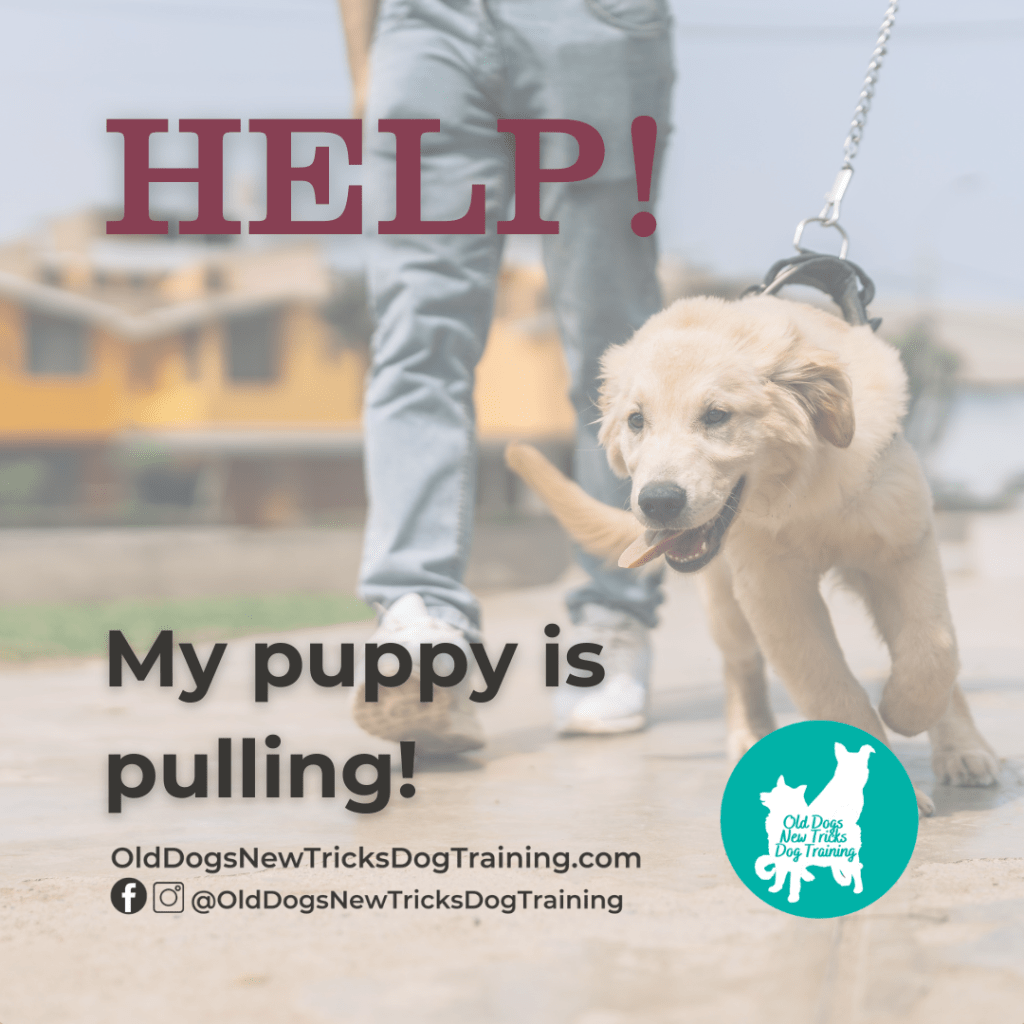
Let’s be honest, when puppies are little leash manners are not always a priority. They are small, it doesn’t hurt that much when they tug, they are easy to control and who wants to distract them when they need to pee. But, the fact is puppies do not come knowing how to walk on leash, or knowing how to pull. And by us letting them pull when they are young we are teaching them that pulling works.
This means that by the time you start to work on leash walking the puppies already have some bad habits. Loose leash walking is probably one of the most frustrating things to teach – that is why there is so much equipment out there designed to manage the pulling. More on that later . . .
So, how do we start creating good habits? First, I drop the leash. Seriously. I build leash walking skills by teaching the dog to follow me, and to know that following me pays. If I can create a connection that does not rely on a physical tether, you won’t need to rely on that leash to control them. And it is simple! You just need a handful of treats, a safe place to be off leash (your living room, kitchen, backyard, etc.), and time. Call your puppy and as you start to walk around, reward them for walking next to you. That’s it. Reward them for walking next to you. It might mean you have to start small and go step, here is a cookie, step, here is another cookie, step, another cookie. Until you have a puppy glued to your side. At this point, it is about cookies, but that is okay, the more you pay, the more attention you get, and you will not need those cookies forever. Just like you do not need to hold a 20 year old’s hand near traffic.
I compare it to tipping your bartender – if you get a drink and leave a dollar, next time you go up they will go to you when it is your turn. You leave a ten, I’m betting they will come help you first. If you didn’t leave anything, get ready for a wait. So tip a ten and get amazing service – they are puppies they can take the calories, use some of their dinner if you need to!
And then start adding some words – when I start to walk I tell a dog “Let’s Go,” when I turn I say “This way!,” and if they start to drift I say “with me!” Use whatever words make sense to you, but be consistent, and remember to give them the cue BEFORE you need it – think of it like using turn signals when driving – get their attention BEFORE the transition. And then you reward them for navigating the transition with you and staying with you – if I turn, when the dog turns with me, they get paid. I don’t use the treat to lure them into the turn, I use my body language, my words, and I wait for them to connect, and pay that. Let them learn that it is part of their responsibility to keep the connection, but remember it is also a part of your responsibility.
You can see me working on what I call “Follow Me” here with Jasper. He is an adult dog, but the mechanics are the same for a puppy.
If you get distracted and just start marching away, you are breaking that connection and you are relying on the leash to let them know when you turn, or give a quick tug, you will start to lose them. Walking together is about relationship, I go to Lowes regularly with my husband and I have never needed to leash him, but we always manage to go through the store together. Because we have a relationship, we look for each other, we talk to each other, we communicate, and we know what it means to walk together – aim for that with your puppy. Because as you learn to communicate and connect it becomes less and less about treats, and more about relationship.
Now, equipment. There are lots of things out there promising to fix pulling, things your friends, family and neighbors will suggest, things you used for your last dog, things that came with the puppy. But you need to assess that equipment and make a meaningful decision on using it – just because it is out there does not mean it is good, or that it will work. And just because something worked for one dog does not mean it will work for THIS dog.
Be aware that most harnesses designed to stop pulling do so because they make it uncomfortable to pull. They tighten and pinch in the arm pits, across the chest, under the belly – you get the idea. Sometimes they work, sometimes the dog decides the discomfort is worth it, or they develop harness aversion. So, I use them with caution, and make sure they are fitted properly to the dog and are not causing stress.
There are also collars designed to control pulling – choke chains, training collars, prong collars, etc. Be warned that these are not suggested by the leading training organizations, and are flat out banned in some countries – why? Well, they rely on pain and punishment, and in some cases fear. And what was discovered is that we cannot control what the dog associates the pain with. Ideally they would pull, it hurts, and they associate the pulling with the pain and stop pulling. However, that is not always what happens. Often they see a dog or person they want to meet, they pull to that dog, child, family member – and it hurts. And the dog associates that pain with the approaching person, dog, child – this can lead to reactivity, anxiety around approaching people, or even aggression.
I do not use tools like that in my training, not only do I find them unnecessary, I find them unethical. I do not rely on pain to train my dogs. As someone with a Masters in education I’ve spent considerable time studying learning theory and strategies. I’m also someone who has spent years teaching dogs and people – I have learned that pain/fear based methods are unnecessary, and less effective. Also, why use them when there are other ways to teach? I want a relationship built on trust with my dogs, and my clients.
We spend a lot of time working on leash walking in Puppy Class and Enrichment, and continue it in Puppy Too. Leash walking skills are often something we forget to focus on, but to me it is one of the most important skills to have.
 Old Dogs New Tricks Dog Training